NOAA Fisheries has published a feature story on the 2026 American Samoa bottomfish life history survey, carried out by the Pacific Islands Fisheries Science Center together with the Department of Marine and Wildlife Resources (DMWR) and local fishermen.
Bottomfish are deep-water species that live at or near the ocean floor and are one of the primary sources of protein for American Samoa residents. They have historically been assessed together as one multi-species complex. Following an independent peer review in 2023, assessments are moving to six key species individually, which requires species-specific information on reproduction, age, and growth:
- Palu-loa (onaga, Etelis coruscans)
- Palu-malau (ehu, Etelis carbunculus, and giant ehu, Etelis boweni)
- Palu-gutusiliva (lehi, Aphareus rutilans)
- Palu-sina (goldeneye snapper, Pristipomoides flavipinnis)
- Palu-ula (gindai, Pristipomoides zonatus)
Highlights
- Community planning. In February 2026, NOAA scientists met with fishing communities on Tutuila and in Manuʻa to plan the survey, and American Samoa residents helped design it.
- Shore-based sampling. Scientists sampled catch from small boats and, alongside DMWR staff, at the third Pago Pago Open Fishing Tournament, where bottomfish were a category for the first time. Local fishery representatives were trained to collect otoliths and gonads so sampling can continue after the survey. 120 fish were sampled in one week.
- At sea. Manuʻa fishers Clint Ilaoa and Keith AhSoon and DMWR representative Shaun Laolagi joined the NOAA team aboard the NOAA Ship Oscar Elton Sette. In 15 days at sea the team collected more than 900 biological samples and met its sampling goals.
- Fish returned to communities. At the close of the survey, DMWR delivered sampled fish to the matai of five islands for distribution to their communities.
- Next steps. The samples are being processed in Honolulu and are enough to begin life history profiles for all six species. American Samoa's bottomfish fishery was last surveyed 10 years ago.
“The most successful way to manage these stocks is to engage the local fishermen,” said Dr. Eva Schemmel of the Pacific Islands Fisheries Science Center.
“They worked hard out there in rough conditions, and they did it the right way, with local fishermen and our Department staff alongside them, with the fish caught going to our communities of Tutuila and Manuʻa,” said DMWR Director Nathan Ilaoa.
Read the full story on NOAA Fisheries · See also the survey photo gallery.
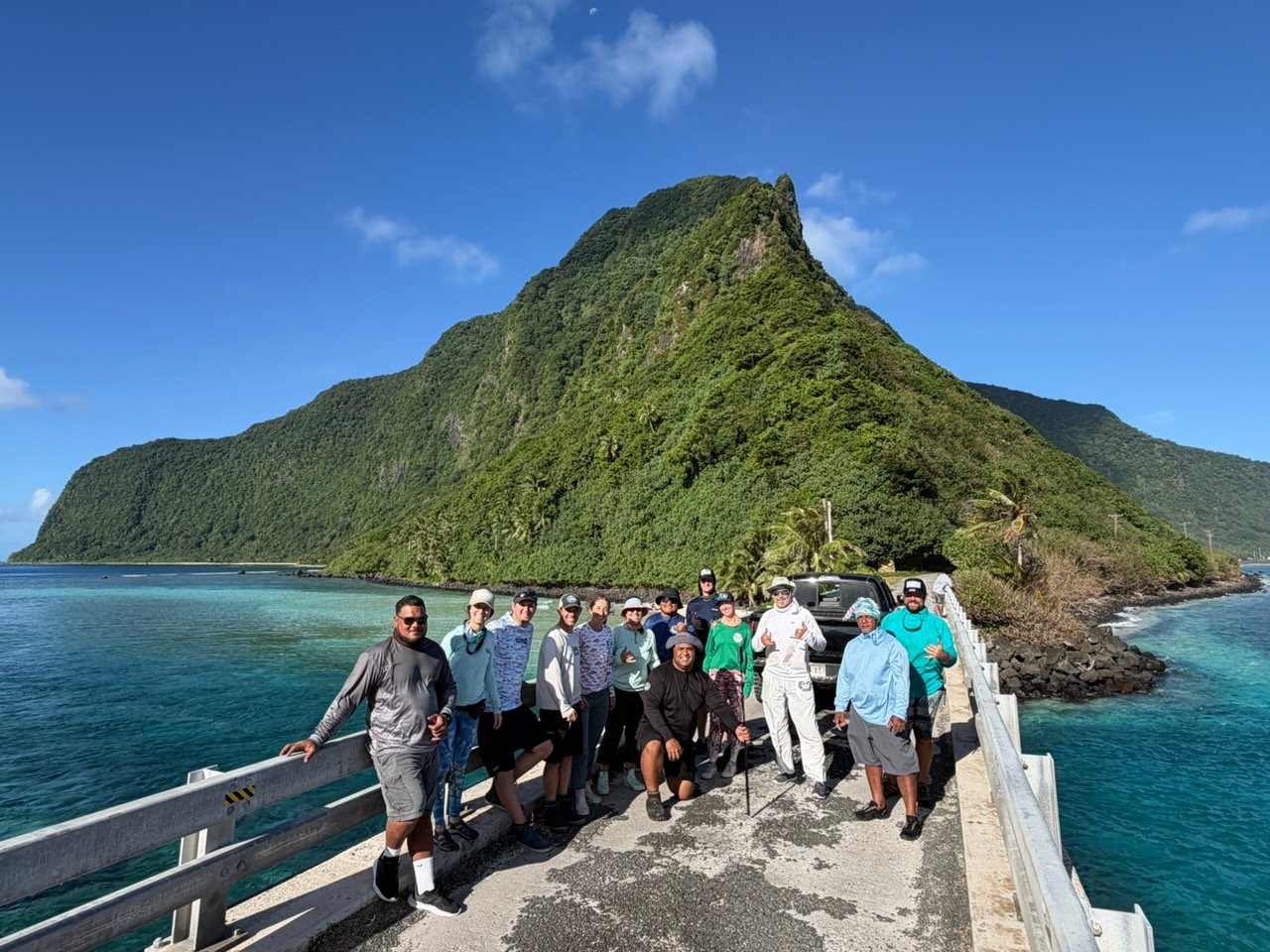
Published by NOAA Fisheries on September 29, 2026. Photo: the survey team on the Ofu-Olosega bridge (NOAA Fisheries).